



Commercial real estate transactions need property condition assessments (PCAs) to supply complete evaluations that analyze building systems, structural strength, and potential maintenance problems. The ASTM E2018 standard is the main industry standard for conducting Property Condition Assessments because it maintains uniformity and reliability throughout reporting processes.
ASTM E2018 has implemented various modifications, establishing better techniques for inspecting commercial properties. ASTM E2018-15 underwent a significant revision as it transitioned to ASTM E2018-20-24 with the primary goals of improving assessment techniques and reporting effectiveness. Real estate and property inspector professionals operating in Ohio, Kentucky, and Indiana must understand the changes between ASTM E2018 versions for compliance and effective assessment processes.
The analysis focuses on ASTM E2018-15 to ASTM E2018-20-24 changes, their influence on commercial property condition assessments, and their consequences during inspections throughout Indianapolis, Louisville, Cincinnati, Cleveland, and Columbus.

Commercial real estate transactions need property condition assessments (PCAs) to supply complete evaluations that analyze building systems, structural strength, and potential maintenance problems. The ASTM E2018 standard is the main industry standard for conducting Property Condition Assessments because it maintains uniformity and reliability throughout reporting processes.
ASTM E2018 has implemented various modifications, establishing better techniques for inspecting commercial properties. ASTM E2018-15 underwent a significant revision as it transitioned to ASTM E2018-20-24 with the primary goals of improving assessment techniques and reporting effectiveness. Real estate and property inspector professionals operating in Ohio, Kentucky, and Indiana must understand the changes between ASTM E2018 versions for compliance and effective assessment processes.
The analysis focuses on ASTM E2018-15 to ASTM E2018-20-24 changes, their influence on commercial property condition assessments, and their consequences during inspections throughout Indianapolis, Louisville, Cincinnati, Cleveland, and Columbus.


ASTM E2018-20-24 introduces advanced definitions for property condition assessment components among its essential updates. Updating multiple definitions within the standard delivers better instructions for inspectors to read physical flaws and necessary remedies consistently.
The official definition makes distinct separations between small regular maintenance tasks and critical problems that need trouble-free or short-duration restoration. Reporting standards become better defined through this revision, proving particularly useful for Indianapolis, Louisville, and Cincinnati.
ASTM E2018-20-24 provides reliable definitions for deferred maintenance to prevent confusing reports regarding cosmetic adjustments.
The standard enables improved financial planning by explicitly separating urgent repairs and tasks that need resolution during the following years.
The walk-through survey stands as the essential component of PCA activities because field observers use it to check visible property conditions. The revised standard ASTM E2018-20-24 presents elevated requirements that specify the boundaries and reporting methods of surveys.
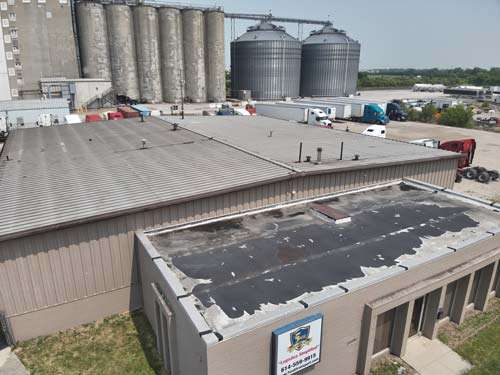
Performing representative building observations has become crucial based on recent inspection requirements to accurately assess the entire property state. ASTM E2018-20-24 strengthens the requirements for inspecting roofs and structures by emphasizing their examination in high-risk areas, including Cleveland and Dayton, due to severe weather hazards.
Inspection transparency increases when inspectors use more defined photographic proof to document building flaws because this approach provides thorough evaluations throughout Cincinnati, Columbus, and Toledo.
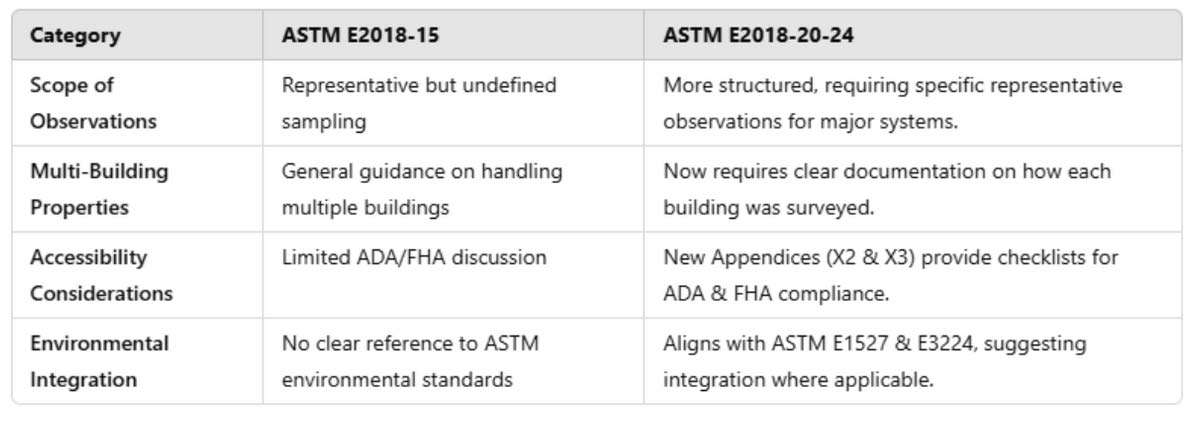
The property condition assessment process depends heavily on conducting document reviews and performing stakeholder interviews, according to ASTM E2018-20-24.
The update encourages inspectors to verify building records through visual close examination for accurate results.
Reports must provide extended building code compliance details since assessments occur in different regulatory settings throughout Columbus, Toledo, and Springfield.
According to the updated standard, equilibrium supervisions of historical maintenance records are needed to detect neglected properties and persisting issues.
A series of important enhancements were integrated into ASTM E2018-20-24 regarding cost estimation methodology compared to ASTM E2018-15. Under the pre-update standard ASTM E2018-15, the cost divisions consisted of three main sections: immediate short-term and long-term costs. Safety-related expenses and code violation correction fall within immediate costs and any failure risks. The price range for short-term expenses included necessary maintenance tasks that would need replacement or repair within one year.
Numerous enhancements exist within ASTM E2018-20-24 that enhance both accuracy and clarity during cost estimation procedures. Upgraded cost documentation standards under ASTM E2018-20-24 require builders to track the expenses of small repairs whose collective expenditure surpasses $10,000 despite keeping the $3,000 minimum threshold steady. The definition of long-term costs now includes a procedure to analyze assets’ remaining helpful life and principal capital expense evaluations for clarity.
A key modification in the standards happens through the enlarged requirements for cost segregation. Consultants must differentiate between maintenance costs, which are ordinary procedures unrelated to PCA, and required repair costs, while upgrade and enhancement costs deal with discretionary enhancements. Using structured processes in cost estimation for property condition assessments becomes clearer through increased cost segregation classification methods.
PCA work results generate Property Condition Reports (PCRs) that contain documented observations, cost predictions, and suggested responses. ASTM E2018-20-24 introduces multiple modifications to ensure a uniform presentation and clear documentation in all report sections.
This standard’s standardized cost estimate procedure defines how to evaluate expenses for replacement and repair, thus minimizing report inconsistency. Property inspectors must adopt specific terminology when assessing maintenance needs in properties across developing suburbs of Cleveland and Columbus, Ohio.
Commercial property report credibility improves by introducing enhanced standards for reporting inspector qualifications to the public.

All commercial property inspectors active in Cincinnati, Columbus, and Cleveland must work under the guidelines of ASTM E2018-20-24. The updated standard sets building code and safety requirements, which help property owners avoid legal risks.
Dayton, Springfield, and Toledo cities should expect property inspectors to adapt their inspection methods to the ASTM E2018-20-24 requirements.
Property inspectors need all documentation logged in detail and should support reports through photographs and complete written documentation.
More efficient interviewing forms part of the inspection process to enable professionals to collect vital property maintenance and construction records.
The structured cost estimation allows property owners to obtain helpful information required for repairs and upgrades.
The additional reporting requirements contribute to longer PCA completion times but enhance the reliability and accuracy of final reports.
Everyone who participates in commercial real estate transactions uses information about property conditions to make better decisions due to transparent property status knowledge.
Commercial property assessments demonstrate enhanced professional standards through detailed documentation, which builds up improved industry standards according to compliance requirements.

Commercial real estate property condition assessments have advanced significantly by adopting ASTM E2018-20-24 from its previous version,
ASTM E2018-15. The upgraded standard enables precise property assessment through improved definitions supported by enhanced survey approaches, better document evaluation methods, and more accurate reporting systems.
The property inspector and real estate professional community operating in Ohio, Kentucky, and Indiana must stay informed about these changes to stay compliant and execute outstanding evaluations. The analysis capabilities of ASTM E2018-20-24 help Indianapolis with Louisville, Cincinnati, Cleveland, and Dayton regions make professional decisions.
Implementing accepted commercial real estate industry practices enables stakeholders, real estate investors and commercial realtors to achieve transactional assurance because their assessment methods reflect current standards.